Going Back to Work While Breastfeeding: A Practical Guide

Can I still breastfeed if I go back to work in Singapore? Yes — and it doesn't have to be perfect to work. Whether you pump, have your baby brought to you during the day, or use formula while you're at work, there's no single way this has to look. The goal isn't to do it “right.” It's to find what fits your life without adding more pressure.
This guide will walk you through the practical steps — from talking to your employer to choosing the right pump — so you can make decisions that work for you and your family.
Talking to Your Employer About Breastfeeding at Work
Before your first day back, it's worth having a conversation with your employer about what you'll need to continue breastfeeding or expressing milk at work.
While paid breaks for milk expression aren't legally mandated in Singapore, you can request them. The Tripartite Alliance for Fair and Progressive Employment Practices (TAFEP) and Ministry of Manpower (MOM) encourage employers to provide reasonable breaks, and many companies are open to offering paid time, flexible use of existing breaks, or other arrangements.
It might feel awkward to bring this up, but most employers are more accommodating than you'd expect when they understand what you need.
What Does Breastfeeding Look Like When You're Back at Work?
Depending on your situation, there are a few different ways this could work:
If someone can bring your baby to you at work: Some mums have a carer bring baby in for feeds during the day. If this is an option for you, it can be a lovely way to maintain direct breastfeeding without needing to pump.
If you'll be expressing milk: Many mums choose to pump during the workday and have their expressed breastmilk given to baby by a carer. This is often the most practical option when you're away from your baby for several hours.
If your baby is older and eating solids: You might breastfeed when you're together and have a carer offer solids and water during the day. Some babies do just fine with this arrangement, especially if they're already established on solids.
If you'll be using formula while at work: Some mums choose to use formula during work hours and breastfeed when they're with their baby. This is a valid choice, and it can work really well if it feels right for you.
There's no hierarchy here. What matters is finding an approach that supports both you and your baby without adding unnecessary stress to your day.
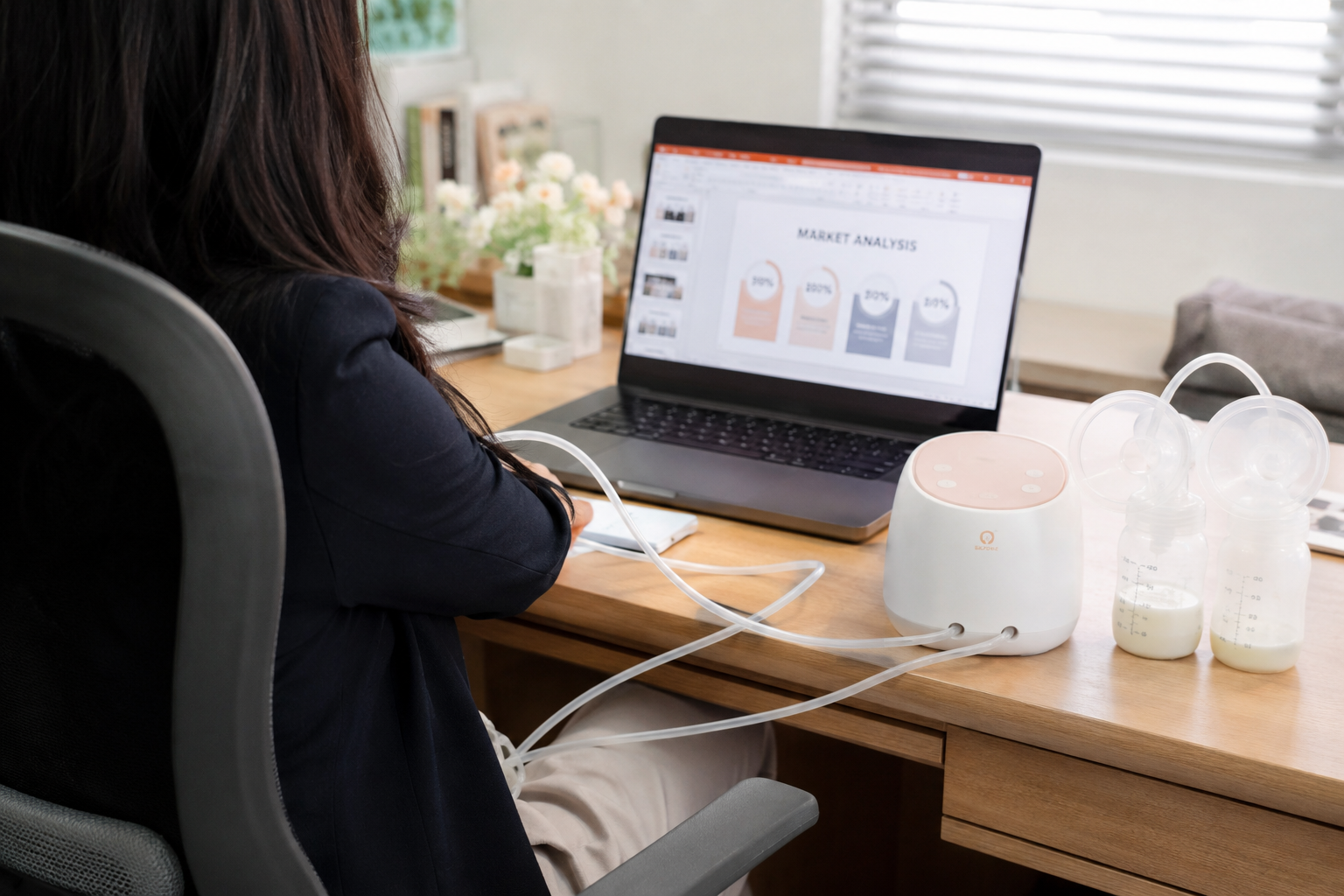
What You'll Need If You're Pumping at Work
If you decide to express milk at work, here's what you and your workplace will need to have in place:
A private space to express with a comfortable chair (not a toilet cubicle)
An accessible power point if your pump requires one
A sink for washing your hands and rinsing pump parts
A refrigerator or freezer for storing your breastmilk
Time to express throughout the day — flexible hours or break times can be helpful, especially in the beginning
A labelled cooler bag and ice brick for transporting your milk home
There's no universal rule that says you must express every three hours, or pump at least twice a day. How often you express is going to be a very individual decision.
It depends on your working day — someone in a quiet office working alone may have different priorities from a police officer, nurse, or school teacher. It also depends on how old your baby is, how often they usually feed during the day, and your own breast storage capacity.
Some women find it helpful to express around the times their baby would normally feed. This can help prevent engorgement, maintain your supply, and ensure you have milk available for your baby the next day. But if that doesn't suit your situation, that's okay too. You'll find what works for you.
What to Do If Pumping Isn't Going Well
It's important to know this: expressing doesn't always come easily, and it can be really disheartening if you're only getting small amounts.
But the volume you express is not always indicative of your supply. Your baby is far more efficient at removing milk than any pump, so please don't assume that what you see in the bottle is all you're making.
Here are a few things that can help:
Try to relax. I know that's easier said than done when you're on a time limit at work, but stress can inhibit your let-down. Looking at photos or videos of your baby can help.
Gentle breast massage or applying warmth before or during pumping can encourage milk flow (though warmth isn't always practical in a workplace setting).
"Hands-on" pumping with breast compressions can help increase the volume you're able to express.
Check your pump parts regularly. If volumes are reducing, it might be time to replace worn-out valves or membranes.
If you've tried all of this and you're still only getting small amounts, or if pumping is taking up so much time that it's affecting your work, it might not be about effort. Sometimes it's one small thing (like flange size) that's getting in the way. I worked with a mum who was power pumping for hours and still struggling. Once we corrected her flange size and adjusted her schedule, her supply improved and she got her time back. You can read more about what we did here.
How to Choose the Right Pump for Work
If you're looking for a breast pump recommendation, it makes sense to invest in something that works efficiently. I recommend a high-quality, double-flanged, motorised pump. Double pumping produces the highest milk yield and releases more oxytocin, which supports your supply.
I never recommend single-flanged pumps or hand pumps for regular use — they're just not efficient enough for most working mums.
Hands-free, wearable pumps can be wonderfully convenient, especially if you need to pump while working or caring for other children. However, they do come with some limitations: they usually have less powerful motors and don't achieve the same milk output as traditional pumps. They can also increase the risk of breast inflammation or mastitis from the pressure of the pump on your milk ducts (60% of which are within three centimetres of the base of your nipple). Just be mindful of these trade-offs if convenience is your priority.
How to Clean and Store Your Milk at Work
Here's something that might make your workday a bit easier: there's a lack of evidence to suggest you need to wash and sterilise pump parts between every pumping session.
Many parents use what's called the "fridge hack": after expressing, put your pump parts in a zip-lock bag and store them in the refrigerator between sessions. If you don't fancy cold drips against you at the next session, you can wipe any wet parts with a paper towel first. Just make sure to wash them thoroughly in warm soapy water once a day when you get home.
Always wash your hands before expressing.
For storing and transporting your milk, you'll need:
- A breast pump
- Some bottles
- Breastmilk storage bags
- An insulated cooler bag with an ice brick
Your expressed milk can stay in the insulated bag for up to 24 hours. When you get home, transfer it to the fridge, and it can be given to your baby's carer the next day.
What to Do If Your Baby Refuses the Bottle
This is one of the most common worries I hear from mums returning to work, and I want to reassure you: your baby will not go hungry.
It's not unusual for babies to initially refuse milk from a carer. It can be stressful to hear about this, but babies are remarkably adaptable. Your baby may:
Make up for missed feeds when you're together, including overnight
Drink more water or eat more solids during the day (if they're old enough)
Accept milk more easily from a carer than from you (sometimes babies can smell mum and hold out for the breast)
Take milk from a cup instead of a bottle
When your baby is truly hungry, they will learn something new. It might take a few days, but they'll figure it out.
In the beginning, it can help to freeze your expressed breastmilk in smaller amounts. That way, if your baby only takes a little, you're not wasting precious milk.
It Doesn't Have to Be Perfect to Work
Returning to work while breastfeeding is a big transition, and it's normal to feel uncertain about how it will all come together. But you don't have to have it all figured out on day one.
Give yourself permission to adjust as you go. What works for one mum might not work for you, and that's okay. The goal isn't perfection; it's finding a rhythm that feels sustainable and supports both you and your baby.
You're already doing more than enough. If you need support to create a plan that actually fits your life — or to troubleshoot once you're back at work — I'm here to help.
If you'd like personalised support with breastfeeding and pumping as you return to work in Singapore, I'm here to help. You can book a session with me or learn more about my postnatal breastfeeding support.
